
In the world of digital marketing, search engine optimization (SEO) plays an important role in helping businesses reach the right audience online. A website may have excellent products, attractive design, and useful information, but without proper SEO, it can be difficult for people to discover it through search engines. One of the most important foundations of successful SEO is keyword research. Keyword research helps businesses understand what people are searching for online and allows them to create content that matches those searches.
In this blog ,we will explore the Importance of Keyword Research in SEO. Keyword research is the process of identifying the words that enter into search engines
Keyword research is not simply about finding popular words and adding them repeatedly to a webpage. Modern keyword research focuses on understanding the needs, questions, interests, and search behavior of users. When businesses understand what their target audience is looking for, they can create more relevant content, improve their search visibility, attract qualified visitors, and ultimately increase conversions.
What Is Keyword Research?
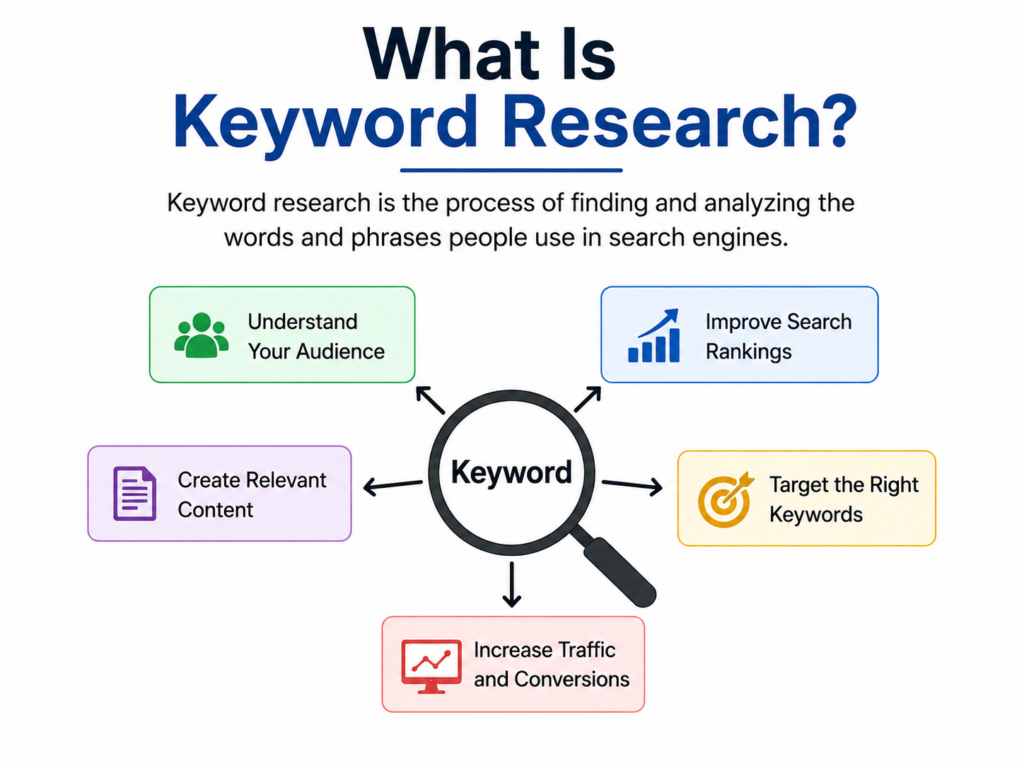
Keyword research is the process of identifying and analyzing the words and phrases that people enter into search engines when looking for information, products, or services. These words and phrases are called keywords or search queries.
For example, imagine someone wants to purchase a pair of running shoes. They might search for phrases such as “best running shoes,” “running shoes for beginners,” “comfortable running shoes,” or “affordable running shoes.” Each search phrase represents a different user need.
For an SEO professional, these searches provide valuable information. Instead of creating content based only on assumptions, marketers can use keyword research to understand what potential customers actually want. This makes keyword research an essential part of planning an effective SEO strategy.
Why Keyword Research Matters in SEO
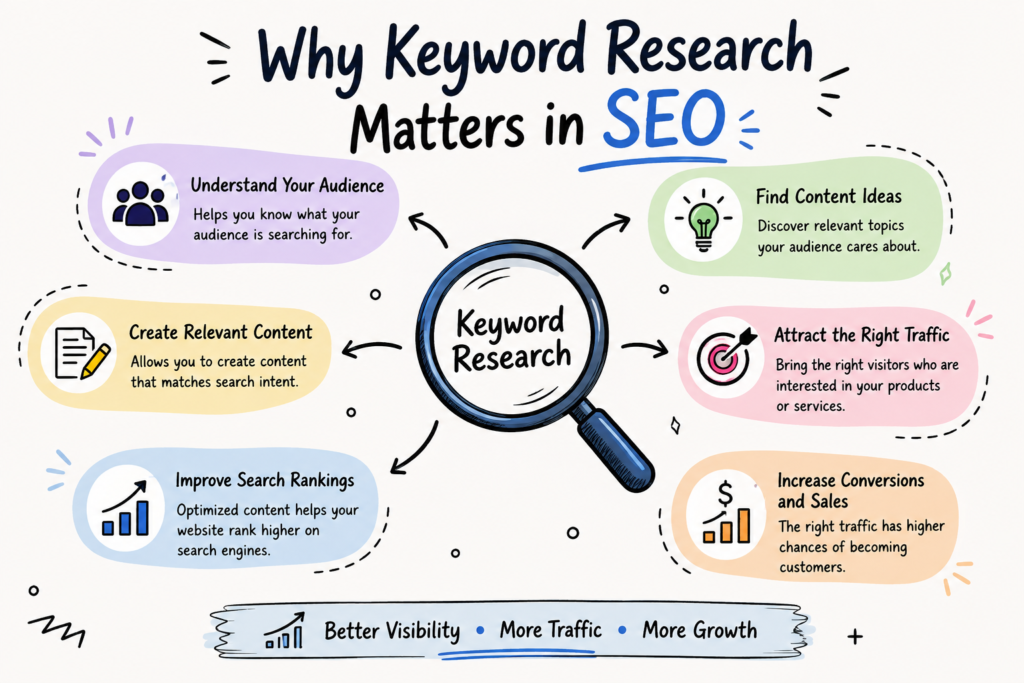
Keyword research provides direction for almost every part of an SEO campaign. It helps marketers decide what content to create, which topics to focus on, and how to structure webpages.
Without keyword research, a business might spend significant time creating content that receives very little search traffic. On the other hand, carefully selected keywords can help a website target relevant users who are already searching for the products, services, or information it provides.
The main purpose is not to attract the largest possible number of visitors. The goal is to attract the right visitors. A smaller number of highly relevant visitors can be more valuable than thousands of people who have no interest in the business.
Importance of Keyword Research in SEO
Understanding Search Intent
One of the biggest advantages of keyword research is that it helps marketers understand search intent. Search intent refers to the reason behind a user’s search.
For example, a person searching for “what is SEO” is probably looking for information. Someone searching for “best SEO agency near me” may be considering a service provider. Another person searching for “buy SEO course online” may be ready to make a purchase.
Understanding these differences allows marketers to create content that matches the user’s expectations. Informational searches may require educational blog posts, while transactional searches may require product pages or service pages.
When content satisfies search intent, users are more likely to stay on the website, explore other pages, and take meaningful actions.
Finding the Right Target Audience
Keyword research can help businesses understand their target audience more clearly. The language people use in search engines can reveal their interests, problems, preferences, and purchasing needs.
For example, a skincare business might discover that its audience searches for “skincare routine for oily skin,” “best moisturizer for oily skin,” and “how to reduce skin dryness.” These searches provide ideas about the questions and concerns of potential customers.
The business can then create useful content around these topics. As a result, keyword research becomes more than an SEO technique—it becomes a way to understand customers.
Improving Website Visibility
Search engines need to understand what a webpage is about before deciding when it should appear in search results. Relevant keywords help provide context.
When keywords are naturally included in important areas such as page titles, headings, URLs, and content, they can help search engines understand the topic of the page. However, keywords should always be used naturally rather than being inserted excessively.
For example, instead of repeatedly using the phrase “digital marketing services,” a website can naturally discuss SEO, social media marketing, content marketing, paid advertising, and other related topics. This creates useful content while still communicating the main subject clearly.
Discovering Long-Tail Keywords
Keyword research also helps marketers find long-tail keywords. These are longer and more specific search phrases.
For example:
- “shoes” is a broad keyword.
- “comfortable running shoes for women” is more specific.
- “comfortable running shoes for women under ₹3000” is even more targeted.
Long-tail keywords often have lower search volumes than broad keywords, but they can be highly valuable because they represent more specific user needs. A person searching for a detailed phrase may already know what they want.
For smaller businesses and new websites, targeting relevant long-tail keywords can be a practical way to compete in search results.
Creating Better Content
Content creation and keyword research are closely connected. Keyword research provides ideas for blogs, articles, product descriptions, landing pages, FAQs, and other forms of content.
Suppose a digital marketing website discovers that people are searching for topics related to “SEO for small businesses.” Instead of writing a general article about SEO, the business can create a detailed guide explaining practical SEO strategies for small companies.
This approach makes content more focused and useful. It also helps businesses answer questions that their audience is genuinely asking.
Supporting Content Planning
Keyword research can help businesses build a long-term content strategy. Instead of choosing blog topics randomly, marketers can organize content around groups of related keywords.
For example, a fitness website might create content around several topic areas:
- Beginner workout routines
- Healthy meal planning
- Weight training
- Home workouts
- Fitness equipment
- Recovery and stretching
Each topic can contain multiple related keywords. This creates a structured content plan and allows the website to cover asubject comprehensively.
Understanding Competition
Keyword research can also provide insights into competitors. By analyzing the keywords that competing websites target, businesses can identify opportunities and gaps.
For highly competitive keywords, ranking may require significant time, strong content, quality backlinks, and website authority. Instead of competing immediately for extremely broad terms, a business may choose more specific keywords that are relevant and achievable.
Competitor keyword analysis can also reveal topics that a business has not yet covered. These opportunities can be used to develop fresh content.
Helping Small Businesses Compete Online
Keyword research is particularly valuable for small businesses. Large companies often have established websites and strong online authority, making it difficult for smaller businesses to compete for highly competitive keywords.
However, small businesses can focus on specific keywords related to their location, niche, products, or services.
For example, a local bakery might target phrases related to its specialty products and location rather than trying to rank for the extremely broad keyword “bakery.” A focused SEO strategy can help the business reach people who are more likely to become customers.
Supporting Local SEO
Keyword research is also important for local SEO. People often use location-based searches when looking for nearby businesses.
Examples include:
- Digital marketing agency in Malappuram
- Best café near me
- SEO services in Kerala
- Beauty salon in my area
By understanding these searches, local businesses can optimize their websites and online profiles for geographically relevant terms.
Local keyword research can therefore help businesses connect with customers who are actively searching for nearby products and services.
Avoiding Keyword Stuffing
Although keywords are important, using too many keywords can negatively affect content quality. This practice is commonly known as keyword stuffing.
For example, repeatedly writing the same keyword in every sentence can make an article difficult to read and may create a poor user experience. Modern SEO focuses more on useful, natural, and relevant content.
The best approach is to use the primary keyword naturally and include related terms where they genuinely make sense. The content should be written primarily for people, while also being easy for search engines to understand.
How to Conduct Effective Keyword Research
A successful keyword research process usually involves several steps.
First, identify the main topic of the business or website. Next, think about the words potential customers might use when searching for that topic. These initial ideas can then be expanded using keyword research tools.
The next step is to evaluate different keywords based on factors such as search demand, competition, relevance, and search intent. It is important to choose keywords that are closely connected to the business rather than selecting keywords simply because they have high search volume.
After selecting suitable keywords, organize them into groups based on related topics. These groups can then be used to plan webpages and content.
Finally, monitor performance and update the strategy when necessary. Search behavior changes over time, so keyword research should not be considered a one-time activity.
Common Keyword Research Mistakes
One common mistake is choosing keywords only because they have high search volume. High-volume keywords can be extremely competitive and may not always bring valuable visitors.
Another mistake is ignoring search intent. A keyword may appear relevant but still represent a different user need than the content provides.
Targeting too many unrelated keywords on one page is another problem. Each page should have a clear topic and purpose.
Businesses should also avoid copying competitors without understanding their own audience. Competitor research is useful, but a successful SEO strategy should reflect the unique products, services, and customers of the business.
The Role of Keyword Research in Modern SEO
SEO continues to evolve, and search engines have become increasingly sophisticated. Search engines can understand context, relationships between words, and the overall usefulness of content.
Because of this, keyword research should not be viewed as simply finding exact-match phrases. It should be used to understand topics and user needs.
For example, if the main topic is “social media marketing,” related concepts might include Instagram marketing, audience engagement, content strategy, social media advertising, analytics, and brand awareness. Covering these related concepts naturally can create more complete and valuable content.
Keyword Research and Business Growth
The ultimate purpose of SEO is not simply achieving a higher ranking. Businesses use SEO to attract potential customers and support growth.
Effective keyword research can help a business appear in front of people at different stages of the buying journey. Some users may be discovering a problem, while others may be comparing solutions or preparing to purchase.
By creating content for these different stages, businesses can build awareness, trust, and customer relationships. Over time, this can contribute to increased organic traffic, leads, sales, and brand visibility.
If you want expert SEO services for your business, contact me,
Conclusion
Keyword research is one of the most important building blocks of a successful SEO strategy. It helps businesses understand what their audience is searching for, identify valuable topics, create relevant content, and improve their visibility in search engines.
The real power of keyword research comes from understanding the person behind the search. Every keyword represents a question, problem, need, or intention. When businesses use this information to create genuinely useful content, SEO becomes more than a method of attracting website visitors—it becomes a powerful way to connect with potential customers.
A strong keyword strategy should focus on relevance, search intent, user needs, and long-term value rather than simply chasing high search volumes. By combining thoughtful keyword research with high-quality content and a well-planned SEO strategy, businesses can build a stronger online presence and create sustainable opportunities for growth.